Though many people walk along Atlantic Avenue in Brooklyn, very few know what Walt Whitman knew, that below Atlantic Avenue once ran the world’s oldest subway. The Atlantic Avenue Tunnel was once part of the Long Island Railroad before it was closed and sunk into relative obscurity. Construction began in 1844, and the tunnel was ordered to be closed in 1859. In 1861, two years after the Tunnel was officially closed, Whitman wrote about it in the Brooklyn Standard as “a passage of Acheron-like solemnity” that would cause us to “grumble less…at God’s handiwork” (307). After Whitman’s nostalgic musings about the tunnel, it practically disappeared from the hearts and minds of Brooklynites for over 100 years. It was not until 1979 that the Atlantic Avenue Tunnel was once again opened to the people of New York by a man named Robert Diamond. Bob heard rumors of the Tunnel and set to work to rediscover it; he did so in 1980. The information that exists between the time of Walt Whitman’s writings on the tunnel and the rediscovery of it by Bob Diamond is full of both facts and creative fantasy.
There were two main reasons why the Tunnel was built. The first reason was for the safety of pedestrians; the street level trains were unable to brake in time and had caused the deaths of two youths. Steam trains did not begin operating in the United States until 1830. Therefore, locomotive travel was new and dangerous; both because pedestrians were unfamiliar with steam trains and because the system of braking had yet to be refined. In 1844 “C. Davis and others, and of William Cook and 170 others” brought forward petitions “requiring the Long Island Rail Road Co. to remove the cars and engines from the street to the wharf and ground near the foot of Atlantic St., and cut through, or tunnel through, the hill on said st…” (‘Common Council’, 2). The safety of Brooklynites was the most plausible reason for moving trains underground, but another source has a different reason for moving the train system underground. The second reason is stated in an article in the Brooklyn Eagle from 1911. According to the article, “The old subway was built that the beauty of Atlantic Avenue, planned to become the finest business highway of any street in any city in America, might not be destroyed”(‘Oldest Subway’, 3). For these reasons the corner stone of the two-train tunnel was laid on May 24th, 1844 and it was open for travel seven months later on the 2nd of December, 1844.
The Atlantic Avenue Tunnel was built by mostly Irish immigrants using the cut and cover method. Cut and cover is a method where a trench is excavated and roofed over. The street was dug up for roughly 12 blocks, a wooden frame was built, a barrel vaulted brick roof put in, and the street relayed. From start to finish the tunnel ranged from one foot to thirteen feet under the street. The entrance to the tunnel was between Boerum Place and Court Street; thus the tunnel is only a foot under Court Street. From there it quickly descends as it gets closer to the East River. Its dimensions are seventeen feet high and 21 feet wide. The terminus of the tunnel is around what was then Emmett Street but is now called Willow Place. Where the tunnel ended is where the train then came above ground and ran for another block and a half; it made a turn and ended between Columbia Street and the East River at a station. Passengers then were within walking distance of the Ferry house. The July 23rd, 1911 edition of the Brooklyn Eagle reported that as of then, the old station still stood but was being used as a double store.
Opening day of the tunnel, December 2nd, 1844, was seen as a day of celebration in Brooklyn. Guests were invited to ride the newly opened rail along with the president of the Long Island Railroad and other important officials. Upon “[r]eturning to the depot, a collation was spread out for their entertainment, at which His Honor the Mayor of Brooklyn presided” (‘Opening Of The Tunnel,2). One engine operated in the front to pull the train while another operated in the back to push it. Because of this dual engine process, the LIRR train was the fastest mode of transportation in the United States at that time. The Atlantic Avenue Tunnel was part of a longer route named the Brooklyn and Jamaica Railroad which ran from the village of Jamaica to the then named East River Front.
Even though one of the reasons why the Atlantic Avenue Tunnel was built was because it was a safety precaution, one should not be led to believe that just because the train was now underground it meant that there were no longer any train-related accidents. There were multiple deaths from the outset. The Brooklyn Eagle states that one man died from falling into the tunnel during construction (‘Petitions’, 2), while the Brooklyn Evening Star writes that one worker was killed during a cave-in (‘Accident’, 2) and an overseer was murdered by a disgruntled employee (‘Reported Murder In Brooklyn’, 3). Another death occurred in 1854 when a man threw himself in front of the train as it began to enter the tunnel. His body was severed into two (‘Shocking Accident’, 3).
These accidents did not decrease the popularity of the Atlantic Avenue Tunnel. Initially, Brooklynites patronized the Long Island Railroad with relish. Yet, for all its initial popularity and profit, the tunnel was closed after sixteen years. The Brooklyn Eagle sites financial trouble in more than one paper. The May 31st, 1896 edition states that, “[i]n 1850 the Long Island road passed into the hands of the supreme court of New York on the foreclosure of a mortgage…” (‘Atlantic Avenue Tunnel’, 18), and the July 23rd 1911 edition states that it was “sold out under foreclosure”. The second reason why it was closed was because of a group of people who organized against the use of steam power on Atlantic Avenue. Their voice was powerful because “[l]egislation went through Albany for the old tunnel from South Ferry to Boerem place to be closed. This was on June 6, 1859” (‘Oldest Subway’, 3). The Long Island Railroad Co. was paid $125,000 to relinquish their rights to the use of steam power within city limits. The tunnel finally closed in the year 1860.
After its closing, the Tunnel was mainly remembered by people who were filing lawsuits against it. Several suits were brought up by men who “were assessed for the closing Atlantic avenue tunnel in 1860…”(‘Long Litigation’, 4). Disgruntled Brooklynites who wished for faster transportation would write into the Brooklyn Eagle with suggestions of re-opening the tunnel (‘Proposition To Re-occupy’, 3). A few men tried to purchase the tunnel (‘The Atlantic Avenue Tunnel’, 3).
But it seems that only one man wrote about the tunnel with nostalgia. That man was Walt Whitman. In 1861, Whitman wrote columns for the Brooklyn Standard. He titled this collection “Brooklyniana”. One long excerpt he wrote was his thoughts about the tunnel. Whitman writes:
The old tunnel, that used to lie there under ground, a passage of Acheron-like solemnity and the darkness, now all closed and filled up, and soon to be utterly forgotten, with all its reminiscences…The tunnel: dark as the grave, cold, damp, and silent. How beautiful look earth and heaven again, as we emerge from the gloom! It might not be unprofitable, now and then, to send us mortals-the dissatisfied ones, at least, and that’s a large portion- into some tunnel of several days’ journey. We’d perhaps grumble less, afterward, at God’s handiwork (306-307).
Whitman realized that the tunnel could give people perspective on life, even if it had outlived its monetary usefulness. What was once supposed to be the seat of splendor was slowly fading out of the minds of most people. By 1902 the articles pertaining to the tunnel had dwindled to reference of dirt being taken from the tunnel to be used to fill stagnant pools of water (‘L.I.R.R.’s New Terminal’, 9). As years went by the tunnel lived on through legends and rumors. People knew or heard of its existence, but by 1911 not only was the question of who owed the tunnel unanswerable, but the entrance to the tunnel seemed to be lost entirely (‘Oldest Subway’, 3 ).
Something as large as the Atlantic Avenue Tunnel can never be forgotten entirely. The tunnel transformed through imagination into a source of literary inspiration. In 1893 a fictional story was published in The New York Times entitled Atlantic Avenue Tunnel- A Romance. This story tells of two friends who go looking for the tunnel after one hears a death-bed confession that it exists and is filled with treasure. They do not find the entrance to the tunnel, much like the 1911 reporter for the Brooklyn Eagle. In 1925 H.P. Lovercraft wrote a story titled The Horror at Red Hook. It is a story of horror and the occult involving a detective who discovers the occult activities in a tunnel underneath a cellar. The cellar collapses on top of the detective and the villains, yet the detective mysteriously lives. The folklore and legends surrounding crime and the Atlantic Avenue tunnel appears to come from the fact that the Atlantic Avenue area had fallen into hard times and developed into a slum called “Smoky Hollow”. The reality of the gangs and slum life, coupled with the mysterious presence of the hidden tunnel allowed for creative writing to flourish. A second fact that may have fed into the folklore of the tunnel being used as a denizen of crime is that a blind distillery was being operated in it at one point. A bar room in an Atlantic Avenue store had a pipe underneath it that led to the distillery (‘Oldest Subway’, 3).
The truth of the tunnel is hidden. Relative obscurity prevailed until very recently. In 1979 whispers and rumors of the forgotten Atlantic Avenue Tunnel reached the ears of a 19-year-old Brooklynite named Robert Diamond through a radio show. Diamond set out to do what so many before him had failed at; he went to find the entrance to the tunnel. Diamond found a copy of the plans in the borough president’s office. He used these plans to locate the entrance; a manhole at Atlantic Avenue and Court Street. When Diamond opened the manhole he found a wall of dirt. This did not deter him and he began using his hands to dig into the tunnel. Under the dirt was a cheap brick wall that Diamond quickly broke through with a metal pole. The other side of the wall revealed a gaping hole that was the Atlantic Avenue Tunnel. Excited with his discovery, Diamond got together a group of volunteers to aid him in hollowing out the tunnel, in order to allow entrance deeper into the tunnel. Now, 30 years after Diamond first heard of the tunnel on the radio, he still holds tours once a month so that interested people may see the tunnel that was almost completely forgotten, save for rumors and fiction writing (Diamond).
There is still some mystery surrounding the tunnel, though, as part of it is still blocked off. According to the Brooklyn Daily Eagle there is an old woodburning locomotive still buried in the depths of the tunnel; Diamond believes this train is what is buried in the yet unexcavated section of the tunnel. Diamond writes on his website, “[a] ccording to oral tradition, back in 1861, an obsolete locomotive was being used by Mr. Litchfield to haul dirt fill for sealing up the tunnel. The crank axle broke, and without the means to repair or remove it, they just left the engine in the backfill at the western end of the tunnel. Perhaps this explains why the tunnel was not fully filled in. Without the means of hauling in more fill, Litchfield decided to simply wall off the tunnel at both ends instead of fully filling it in” (Diamond). Until the entire tunnel is excavated, what really is hidden behind the wall will remain a mystery.
From the Atlantic Avenue Tunnel’s inception on December 2nd, 1844 there has been a rich history that is both factual and fictional, even if for many years the tunnel was silent. Originally built for the safety and beautification of Brooklyn, it was not without its own share of accidents and tragedies including one murder. The tunnel was very popular and profitable in the beginning but was in operation only until June 6th, 1859 because of financial trouble and public outcry against steam power. It is after the closing that the tunnel’s history becomes more of a mystery. Once boarded up, people tried for many years to find an opening and failed. Writers saw the tunnel as a source of inspiration for stories that may have had some grains of truth in them. The slums and crime that arose around the area where the tunnel exists were also a source of inspiration for these writers. It was not until 1980 that the tunnel was rediscovered by a young Brooklynite named Robert Diamond. Diamond and volunteers dug through dirt and brick in order to re-enter the tunnel and make it accessible for tours. New Yorker’s with an interest in the underground history of the Atlantic Tunnel can now come and explore, and even contemplate the ongoing mystery of what lies in the unexcavated portion of the tunnel or whether re-opening the tunnel would be profitable for Brooklyn and the Long Island Railroad.
Barrel-Vaulted Tunnel 
Works Cited
Whitman, Walt. The Uncollected Poetry And Prose Of Walt Whitman: Much Of Which Has Been But Recently Discovered With Various Early Manuscripts Now First Published. Ed. Emory Holloway. 1st ed. Vol. 2. Garden City: Doubleday, Page & Company, 1921. Print.
“Common Council.” Brooklyn Daily Eagle 16 Jan. 1844, Vol. 3 ed., No. 29 sec.: 2-2. Brooklyn Daily Eagle Online. Web. 1 Dec. 2009. <http://eagle.brooklynpubliclibrary.org/>.
“Brooklyn Has The Oldest Subway In The World.” The Brooklyn Eagle 23 July 1911, Vol. 71 ed.: 3-3. Print.
“Opening Of The Tunnel.” The Brooklyn Eagle 05 Dec. 1844, Vol. 3 ed., No. 294 sec.: 2-2. Brooklyn Daily Eagle Online. Web. 1 Dec. 2009. <http://eagle.brooklynpubliclibrary.org/>.
“Petitions.” The Brooklyn Eagle 17 Sept. 1844, Vol. 3 ed., No. 226 sec.: 2-2. Brooklyn Daily Eagle Online. Web. 1 Dec. 2009. <http://eagle.brooklynpubliclibrary.org/>.
“Accident.” Brooklyn Evening Star 11 July 1844: 2-2. Print.
“Reported Murder In Brooklyn.” Brooklyn Evening Star 29 May 1844: 3-3. Print.
“Shocking Accident On The Long Island Railroad.” The Brooklyn Eagle 27 Sept. 1854, Vol. 13 ed., No. 226 sec.: 3-3. Brooklyn Daily Eagle Online. Web. 1 Dec. 2009. <http://eagle.brooklynpubliclibrary.org/>.
“Atlantic Avenue Tunnel.” The Brooklyn Eagle 31 May 1896, Vol. 56 ed., No. 151 sec.: 18-18. Brooklyn Daily Eagle Online. Web. 01 Dec. 2009. <http://eagle.brooklynpubliclibrary.org/>.
“A Long Litigation Over the Matter of the Asessment for the Closing of the Tunnel.” The Brooklyn Eagle 28 Feb. 1873, Vo. 34 ed., No. 5 sec.: 4-4. Brooklyn Daily Eagle Online. Web. 1 Dec. 2009. <http://eagle.brooklynpubliclibrary.org/>.
“Proposition to Re-occupy the Atlantic Avenue Tunnel- Railroad Management.” The Brooklyn Eagle 12 Aug. 1873, Vo. 34 ed., No. 190 sec.: 3-3. Brooklyn Daily Eagle Online. Web. 1 Dec. 2009. <http://eagle.brooklynpubliclibrary.org/>.
“The Atlantic Avenue Tunnel.” The Brooklyn Eagle 5 July 1876, Vol. 37 ed., No. 158 sec.: 3-3. Brooklyn Daily Eagle Online. Web. 1 Dec. 2009. <http://eagle.brooklynpubliclibrary.org/>.
“L.I.R.R.’s New Terminal At Rockaway Beach.” The Brooklyn Eagle 29 Dec. 1902, Vo. 62 ed., No. 359 sec.: 9-9. Brooklyn Daily Eagle Online. Web. 1 Dec. 2009. <http://eagle.brooklynpubliclibrary.org/>.
“Atlantic Avenue Tunnel – A Romance.” The New York Times 23 Jan. 1893: 10-10. The New York Times. Web. 1 Dec. 2009. <http://query.nytimes.com/mem/archive-free/pdf?_r=1&res=9907EEDF1031E033A25750C2A9679C94629ED7CF>.
Lovecraft, H.P. Weird Tales: Seven Decades of Terror. New York: Barnes and Noble Books, 1997. Print.
“Interviewing Bob Diamond.” Personal interview. 6 Dec. 2009.
Image- http://upload.wikimedia.org/wikipedia/commons/e/e6/Barrel_vault_top_force.jpg
Please enable Javascript and Flash to view this Flash video.
Please enable Javascript and Flash to view this Flash video.
Please enable Javascript and Flash to view this Flash video.
 The trip to the Brooklyn Historic Society was of great interest to me as I am an avid fan of all things Brooklyn. It came as a surprise to me of its location at the corner of Clinton and Pierpont as I am down in that area quite often and had not realized that such a great resource was so close by. Upon approaching the large red brick building the architecture was overpowering.
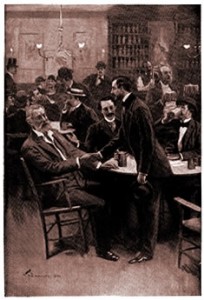 The history of the Vault at Pfaff’s is the history of not only a place, but of the people who frequented its tables. The Vault was opened in 1855 by Charles Ignatious Pfaff, a foreigner with ascetic tastes, on Broadway near the corner of Bleeker Street. Sources disagree as to the exact address of the original Pfaff’s, with one stating it as 689 Broadway (Reynolds 376) and another as 653 Broadway (Miller 89). Regardless of the exact address, Pfaff’s was located in the heart of what was then a cultural hub of New York, Greenwich Village. Pffaf’s was dark and smoky with tables, seats and barrels for sitting on that were scattered around; it was known for its coffee, German beers, cheeses, and a fully stocked wine cellar (Miller 89). This setting attracted the budding Bohemian literary movement of the time. The original Bohemian lifestyle was born in France. Initially it was the necessary lifestyle of the starving artist, but soon it became romanticized into an ideal of shunning the emerging capitalist way of life and embracing art as the greatest truth. This romanticization emigrated to New York and found its home in Greenwich Village. Men were the most frequent visitors at Pfaff’s but, because of progressive ideals of the Bohemian mindset, women with strong characters also became famous frequenters. The Vault at Pfaff’s was so centrifugal to the Bohemian movement in America that the first group of American Bohemians became simply known as “Pfaffians”.
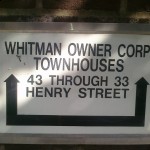
 . What was most interesting of this spot was that Whitman himself worked here in the Rome Brother’s Print Shop. I particularly enjoyed this because it evoked for me the memory of reading about his work in the printing shop previously, at the age of 12 written about in Walt Whitman’s New York. In this particular passage he states, “What compositor, running his eye over these lines, but will easily realize the whole modus of that initiation? -the half eager, half bashful beginning- the awkward holding of the stick- the type-box, or perhaps two or three old cases, put under his feet for the novice to stand on, to raise him high enough- the thumb in the stick- the compositor’s rule- the upper case almost out of reach- the lower case spread out handier before him- learning the boxes- the pleasing mystery of the different letters, and their divisions- the great ‘e’ box- the box for spaces right by the boy’s breast- the ‘a’ box, ‘i’ box, ‘o’ box, and all the rest- the box for quads away off in the right hand corner- the slow and laborious formation, type by type, of the first line- its unlucky bursting by the too nervous pressure of the thumb- the first experience in ‘pi’, and the distributing thereof- all this, I say, what journeyman typographer cannot go back in his own experience and easily realize it?” (48). As we proceeded to the second location we passed the housing named after Walt Whitman (44-33 Henry Street)
 . The second stop, Plymouth Church
 , was moving, especially upon entering the old church. It had the feel of being in the past as one of the students sat in the same row as Lincoln did many years earlier. One of the unusual things about the church was that the stained glass made no reference to angels or gods, they reflected men. The church was known for its involvement in the abolitionist movement and was part of the Underground Railroad. It was striking to me to hear that they had reverse slave auctions in where white people would buy the slaves’ freedom. The curator told us of one particular auction that involved “Pinkie”. Like her name, she was very light skinned, as her father was a white man. Being the daughter of a slave woman, she, despite appearance, was still bound to slavery until her freedom was bought at Plymouth Church. New York Magazine writes, “Most notable was the time a parishioner placed a small gold ring in the offering plate for a young slave girl named Pinkie, who returned to the church in 1927 to give thanks (and to return the ring)”(The Plymouth Church of Pilgrims, http://nymag.com/listings/attraction/plymouth-church-of-the-pilgrims/). Jesse Merandy then lead us down to the Brooklyn Promenade which gave us the vantage point of looking across that river as Whitman did many years ago before the Brooklyn Bridge was built. They say Whitman lived long enough to see the magnificent footings of the bridge constructed, but I am not certain that he ever crossed the bridge. We could see the waterways in which the ferries moved the residents of Brooklyn to the city of Manhattan.
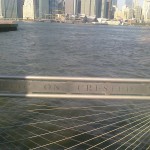
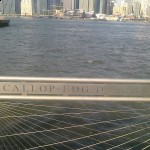
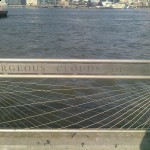
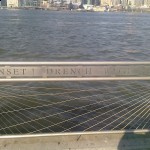
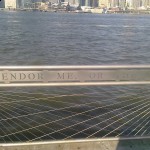
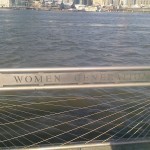
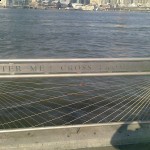
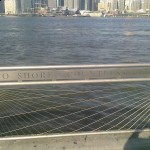
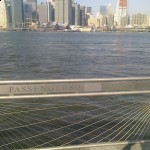
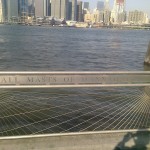
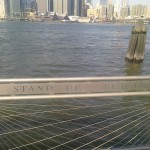
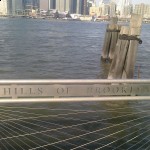
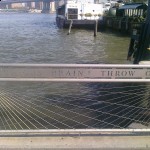
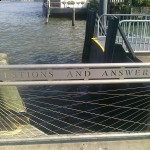
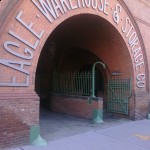 . I had been aware of the Eagle Warehouse for most of my life but had never made the connection that the Brooklyn Daily Eagle, which I was aware of, was printed there, and through this course finding that Walt Whitman wrote for the Daily Eagle. You could tell that part of the building was much older than others and had been added upon over time. It was very cool to be standing on a cobblestone street listening to Jesse Merandy, a Whitman scholar, speak of Whitman. As we attempted to go to our final stop, the Fulton Pier, it was closed due to a film shoot, so we wrapped up the tour there. Some of us went for pizza and some of us went back to school. I returned the next day to the Fulton Pier and stood upon the Pier, closed my eyes, and tried to imagine what it must have been like 150 years ago. Then I read the railing that had embedded in it the words of Whitman
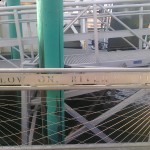
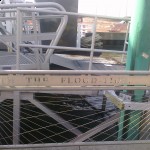
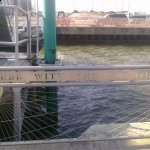

 .
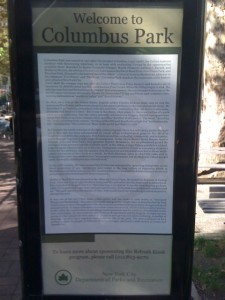
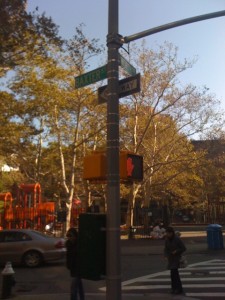
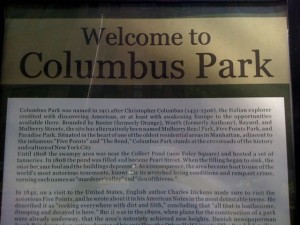
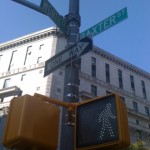 . Having parked my car on Mott, a block from Doyer, I had to pass through Columbus Park to get to Worth and Baxter. While in Columbus Park I came across the above pictured sign. It further confirmed the description that Dickens’ gave of the 5 points in his review of New York. The sign read as follows, “In 1842, on a visit to the United States, English author Charles Dickens made sure to visit the notorious Five Points, and he wrote about it in his American Notes in the most scathing terms. He described it as ‘reeking everywhere with dirt and filth,’ concluding that ‘all that is loathsome, drooping and decayed is here'”. The sign also quotes Danish newspaperman Jacob Riis and his description of the area in the 1890’s. It states, “Jacob Riis devoted an entire chapter of his epic How the Other Half Lives to ‘The Bend,’ detailing the ‘foul core of New York’s slums.’ He likened the filth and dearth of sunlight to a “vast human pig-sty,’claiming that “There is but one ‘Bend’ in the world, and that is enough.'” As I was reading the sign I introduced myself to an employee of the Parks Dept. to find the exact location of the Five Points. He suggested I was in the thick of it. Then I inquired where was the corner of Worth and Baxter and he pointed to a corner of the park. As I began to head in that direction I was approached by an elderly Asian woman who asked if I wanted to see the oldest part of the area. I said “yes”. She directed me to 15 Doyers St
 . which was very close to where I parked the car. She had suggested that there was a passageway under the buildings about three stories down. I was excited to hear this as Dickens has been in my head since reading his review of New York, especially the part where he describes, “Ascend these pitch-dark stairs, heedful of a false footing on the trembling boards, and grope your way with me into this wolfish den, where neither ray of light nor breath of air, appears to come. A negro lad, startled from his sleep by the officer’s voice-he knows it well-but comforted by his assurance that he has not come on business, officiously bestirs himself to light a candle. The match flickers
 which furthered my feelings of an unkempt underground passage. There were several staircases and some closed exits blocked by garbage cans
 ; it felt as though I traveled several stories underground before finding myself at the foot of the stairs. I then proceeded down a winding and turning hallway
 which felt as though it was longer than two city blocks. There were several shops, most of them abandoned, and the few that were open (one being an employment agency) had signs written in Chinese. It gave an overall feeling of being in an unfamiliar place, such as Dickens must have felt on his first voyage to New York. At the end of the long and winding corridor I found myself looking up a long flight of stairs with an exit sign. As I proceeded up the stairs I felt the sunlight shining
 in through the glass door and walked out into Chatham Sq.
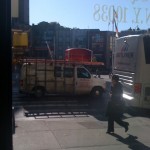 After my impromptu adventure, set off by the elderly Asian woman, I returned to the corner of Baxter and Worth
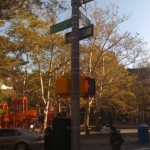 and took in the view of the Five Points (Columbus Park) from that vantage point. It being so early in the morning with so few inhabitants it was easy to imagine what it must have been like in the 1800’s thanks to the culmination of the readings, the park, and my short adventure underground.